News
2026-10-08
Leading AI Server Makers in Korea: 2026 Guide to the Companies Building the Korean AI Server
If Taiwan is where the AI factory is assembled, Korea is where many of its most critical parts are made.
Our Taiwan guide followed eight companies that turn GPUs into racks. A Korean version of that list does not exist. Korea has no Foxconn, no Quanta, no Wiwynn.
Instead, Korea's AI infrastructure looks like a ring of world-class suppliers around an empty center:
Memory that every accelerator depends on.
AI chips designed for inference.
Liquid cooling now approved for NVIDIA AI factories.
Power infrastructure shipping to U.S. hyperscale sites.
Cloud operators building gigawatt-scale AI data centers at home.
The missing piece is the server and rack integrator that ties these together.
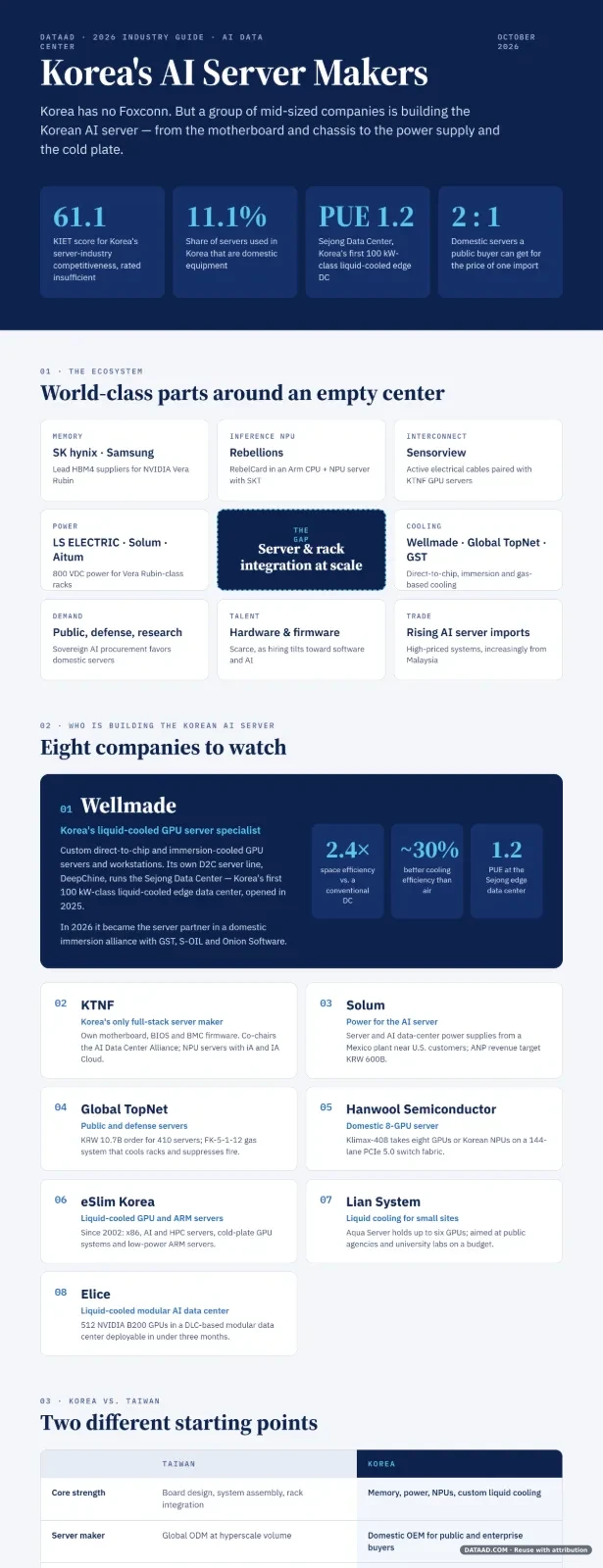
That gap is now a national topic. A May 2026 study by the Korea Institute for Industrial Economics and Trade (KIET) rated Korea's server industry competitiveness at 61.1 points, described as insufficient. It flagged a widening trade deficit driven by imports of high-priced AI servers, increasingly from Malaysia since 2024.
The same study argued that, at minimum, public and defense systems should be built on domestic server capability.
This guide maps who is building what in Korea's AI server ecosystem in 2026, and what it would take for Korea to build the AI factory, not just supply it.
DATAAD 2026 Korea AI Infrastructure Map

This is an editorial overview rather than a market-share ranking. Scale varies widely: most of these companies are a fraction of the size of a Taiwanese ODM, and several are only now moving from general servers into AI systems.
1. Wellmade — Korea's Liquid-Cooled GPU Server Specialist
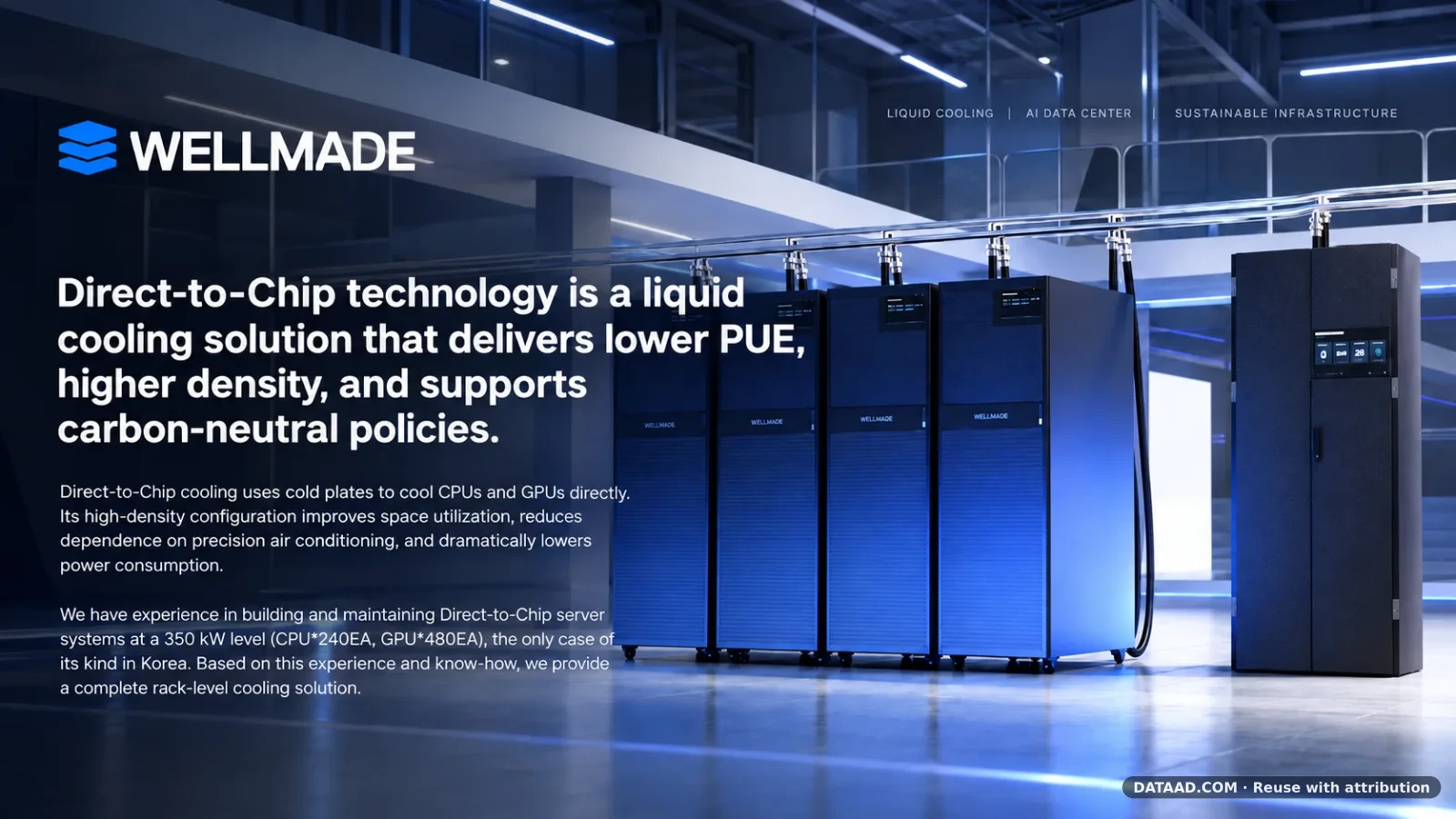
Wellmade builds the kind of AI hardware Korea's research labs, universities and enterprises can actually install: custom liquid-cooled GPU servers and workstations.
At Seoul's 2025 mechanical equipment show, exhibiting with immersion-cooling partner Immerscool, Wellmade presented its approach:
Direct-to-chip (D2C) liquid-cooled servers, with leak sensors on each GPU and CPU and hoses running to a rear-rack manifold so every chip receives coolant at the same temperature.
Immersion cooling, including single-phase dielectric fluid and two-phase systems that boil near 50°C.
A liquid-cooled tower workstation that takes up to seven GPUs and runs below 45 dB, for teams with no server room.
Its flagship reference is the Sejong Data Center, which opened in 2025 as Korea's first 100 kW-class liquid-cooled edge data center. Wellmade supplied the site's liquid-cooling servers, built on its own D2C server line, DeepChine.
Space: more than 2.4 times the space efficiency of a conventional data center.
Cooling: about 30% better cooling efficiency than an air-cooled facility.
Energy: a PUE of 1.2.
CEO Park Chang-beom has stressed that long-term stability, not just cooling performance, was the design priority: coolant lines run from the rack manifold through quick-connect hose kits to cold plates on each chip, so servers can be serviced without draining the loop.
In 2026, Wellmade Computer was named the server partner in a new immersion-cooling alliance. Global Standard Technology (GST) unveiled a modular 24U, 120 kW single-phase immersion system with S-OIL at HVAC Korea in May, and plans to combine its tanks, S-OIL's fluid, Onion Software's monitoring and Wellmade's servers.
DATAAD View:
Wellmade tackles the most common objection to direct liquid cooling — leaks — at the server level, and now sits inside a full domestic immersion stack. Its next challenge is turning custom builds into repeatable, validated rack products that larger buyers can standardize on.
2. KTNF — Korea's Only Full-Stack Server Maker
KTNF is the closest thing Korea has to a domestic server OEM.
Founded in 2001 by a former LG engineer, the company designs its own server motherboards and firmware, and competes against roughly 20 multinational vendors. It has about 100 employees, more than 40% in R&D, and reported revenue of roughly KRW 26 billion last year.
Its in-house stack covers BIOS, BMC firmware and enclosure design. Its KR580S2 server earned what the company calls the world's first audited TPCx-AI result.
2026 has been KTNF's busiest year:
NPU servers: In July, KTNF agreed with iA and IA Cloud to co-develop Korean AI servers with domestic NPUs for the NeoCube small data-center platform, with demonstration sites in Hwaseong and Gyeongju.
Interconnect: In August, it signed with Sensorview to pair its GPU servers with active electrical cables and RF interconnects.
Policy role: KTNF co-chairs the Ministry of Science and ICT's AI Data Center Alliance, which spans servers, chips, networking, power and cooling.
Export: It is pursuing sovereign AI projects in Vietnam and the Philippines through technology transfer.
DATAAD View:
KTNF's scale is small next to Taiwan's ODMs. Its strategic value is control of the board, firmware and supply chain — exactly what "sovereign AI" procurement now asks for.
3. Solum — Powering the AI Server
Solum does not assemble servers. It builds what every AI server needs before it can switch on: the power supply.
The KOSPI-listed company grew up making switched-mode power supplies for TVs and phone chargers. Its ANP (automotive and power) division now supplies power for standard servers and AI data centers, alongside EV charging components, according to executive vice president Yoo Dong-kyun in a March 2026 interview.
Key points from that interview:
Solum is working on power solutions optimized for NVIDIA and AMD AI platforms.
Its Mexico plant lets it supply server power to North American customers close to home, with tariff advantages.
The ANP division expects 2026 revenue above KRW 200 billion and targets KRW 600 billion in revenue and KRW 90 billion in operating profit within three years.
DATAAD View:
In Taiwan, Delta and LITEON grew from PC power supplies into rack power shelves. As AI racks head toward 800 VDC and megawatt-class power, Solum is Korea's clearest candidate to follow that path — if it can win design-ins at the server and rack level, not just the box level.
4. Global TopNet — Public-Sector Servers With Built-In Fire Safety
Busan-based Global TopNet is a domestic server maker focused on public and defense customers.
It has supplied servers to the National Security Research Institute and the Korea Aerospace Research Institute, including the Naro rocket data-backup server. In February 2026, it signed a KRW 10.7 billion contract with the Public Procurement Service for 410 high-performance servers. In August, it won a cloud infrastructure project for the Defense Agency for Technology and Quality.
Its signature technology is a fluorinated-ketone (FK-5-1-12) gas system that both cools the rack and suppresses fires at an early stage. It earned a Ministry of SMEs and Startups commendation in December 2025.
KOSDAQ-listed Aitum has taken a strategic stake and plans to put its high-efficiency PSU modules into Global TopNet's AI server platform.
DATAAD View:
Global TopNet shows how Korean server makers are winning: in public procurement, with safety and sovereignty as selling points. Recent Korean press reports note that soaring memory prices have widened the price gap with imported servers to the point where a public buyer can get roughly two domestic servers for the price of one foreign unit.
5. Hanwool Semiconductor — A Domestic 8-GPU Server
Hanwool Semiconductor, together with affiliate Hanwool Materials Science, has entered the AI server market with the Klimax-408.
Up to eight GPUs or domestic NPUs per server.
A 144-lane PCIe 5.0 switch fabric, aimed at higher throughput and lower system cost.
Target uses include LLMs, autonomous driving, industrial AI and defense AI.
The company frames the product against a striking figure: domestic equipment accounts for only about 11.1% of servers used in Korea.
DATAAD View:
A PCIe-switch design that accepts both GPUs and Korean NPUs is a practical bridge. It lets public buyers adopt domestic accelerators without betting an entire cluster on them.
6. eSlim Korea — Liquid-Cooled GPU and ARM Servers
Founded in 2002, Seoul-based eSlim Korea builds x86, AI and HPC servers and storage.
Its portfolio reaches into two areas most domestic vendors have not: fully liquid-cooled GPU servers and workstations, with both CPU and GPU on cold plates, and low-power ARM servers for data centers.
DATAAD View:
ARM is moving into the AI data center fast, from NVIDIA Grace and Vera to the Arm AGI CPU. A domestic vendor with ARM server experience could matter as Korean NPUs begin pairing with ARM hosts.
7. Lian System — Liquid Cooling for Small Sites
Lian System is bringing liquid-cooled AI servers to buyers that have no data center at all.
At Smart Tech Korea 2026 in June, it showed the Aqua Server, a liquid-cooled server that holds up to six GPUs. The company plans to list it on Korea's public procurement marketplace in the second half of the year, targeting public agencies and university research labs that run AI compute in small server rooms.
Its pitch is cost. Liquid-cooled servers have so far been led by large global vendors; Lian aims to offer high-performance AI servers to small companies and offices at a lower price.
At the same show, H3 Solution took a similar route with its Nautilus 4U and 5U liquid-cooled servers and an H3NautiPOD edge data-center module.
DATAAD View:
Liquid cooling is usually discussed as a hyperscale technology. Lian System and H3 Solution point to a second market: the university labs, public agencies and small firms whose GPU servers already overheat in ordinary server rooms.
8. Elice — A Liquid-Cooled AI Data Center in Three Months
Elice, best known as an AI education platform, has become one of Korea's most visible users of direct liquid cooling.
It built what it calls Asia's first DLC-based portable modular data center (PMDC): a cluster of 512 NVIDIA B200 GPUs supplying compute for the Ministry of Science and ICT's AI Specialized Foundation Model project. Elice says the modular design can be deployed in under three months, against roughly three years for a conventional data center.
DATAAD View:
Elice is not a server maker, but it shows the demand side. Fast, modular, liquid-cooled AI capacity is exactly the kind of project Korean liquid-cooled server makers need to win.
Around the Server: What Korean Server Makers Can Build On
Korea's server makers are small, but the components around them are world-class:

The gap is integration. The KIET study also warned that hardware and firmware engineers are scarce, as hiring tilts toward software and AI.
Korea vs. Taiwan: Two Different Starting Points

Taiwan built the AI factory from the motherboard outward. Korea is approaching it from the outside in — from memory, cooling and power toward the server.
Which Companies Should Buyers Watch?

These are DATAAD editorial characterizations, not purchasing recommendations. Supplier fit depends on platform, volume, support, cooling architecture and certification.
DATAAD Insight
Taiwan's lesson is that AI server leadership comes from integration, not from any single component.
Korea already owns several of the hardest pieces: the HBM inside the GPU, 800 VDC power gear, domestic inference NPUs and a growing group of liquid-cooled server makers. What it lacks is a company that combines them into a rack at scale.
Three things could change that:
A domestic anchor customer. Public AI centers and sovereign AI projects that specify domestic servers would give Wellmade, KTNF, Global TopNet and Hanwool the volume to invest.
Liquid cooling as a product, not a project. Validated, repeatable liquid-cooled servers and racks would let Korean makers move from lab installations to data-center orders.
Open standards. OCP-style open rack, power and cooling specifications let smaller makers build to the same interfaces as global ODMs instead of reinventing them.
Korea does not need its own Foxconn to matter in the AI factory. It needs its component leaders and its server makers to start designing together.
DATAAD 2026 Industry Guide. This guide is based on public company materials and Korean and international press reports as of October 2026. It is an editorial overview rather than a market-share ranking.